
Kadangi ta technikos sritis MF dar nepasiekta, tai dedu bent jau paskaityt...
Amerikosaimle, visko ten jie turi.
copyrightas kazkokio tai dedes is USA/Idaho
OK time for some more tech

What you are looking at is one of the most advanced motorcycles ever made, and I don’t say that lightly.
First let’s take the obvious: weight. In 1976 my trials bike weighed about 210 lbs and my RM 250 weighed about 230 lbs. Today the equivalent MX bike weighs almost exactly the same (though my SX is lighter). This gas gas weighs 146 lbs. 300cc 146lbs.
You will never see a smaller 300cc motor. It’s incredibly narrow. GG invented the hydraulic clutch, and the lever pull is the lightest of any clutch on any bike. It will rev as high as any MX two-stroke, with great smooth power off idle. It has a 6-speed and will go close to 70 with stock gearing, but of course I’ve never gone that fast. The rear rim is the only tubeless spoked wheel you’ll see, except on other state of the art trials bikes.
That’s the good news. The bad news is that it’s a very specialized bike, not often employed for exploration purposes. Obviously the first issue is range. You aren’t going far with that tank. Most trials guys PACK their fuel on the trail, if you can believe that. You’d think a bigger tank would be no big deal, just send off for it. Hah!
I finally found a picture of this tank on the internet. The only one in the USA is now on my bike.
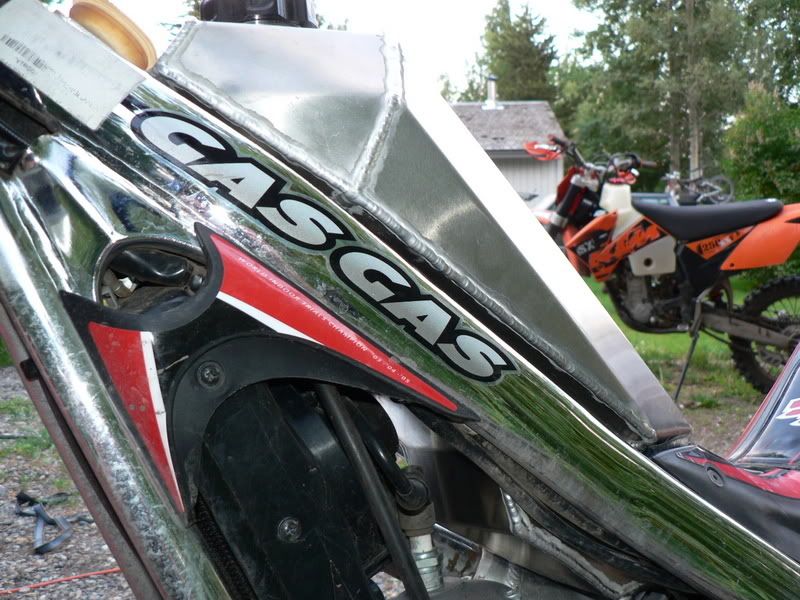
I had to track down a dealer who actually had one, turns out this was in france, and beg him to learn paypal and take 350.00 for it. I also bought a wildly expensive little seat----from france again.

Now this brings up an interesting point,----what is the deal with the no seat and the huge dip under your crotch? As soon as you ride the bike in a knarly place you understand right away why it’s like this. The dip allows you to catch almost any low speed fall with a dab. Say you are traversing on a narrow trail across a ridge face. On your endure bike if you start to fall downhill, it’s over. Giant bench press of upside down bike coming up. On a modern trials bike you just put your foot down. I don’t care how short you are, anything short of a cliff and you can catch the bike. Not only that, but the center of gravity is so low and the bike is so light, the recovery is effortless.
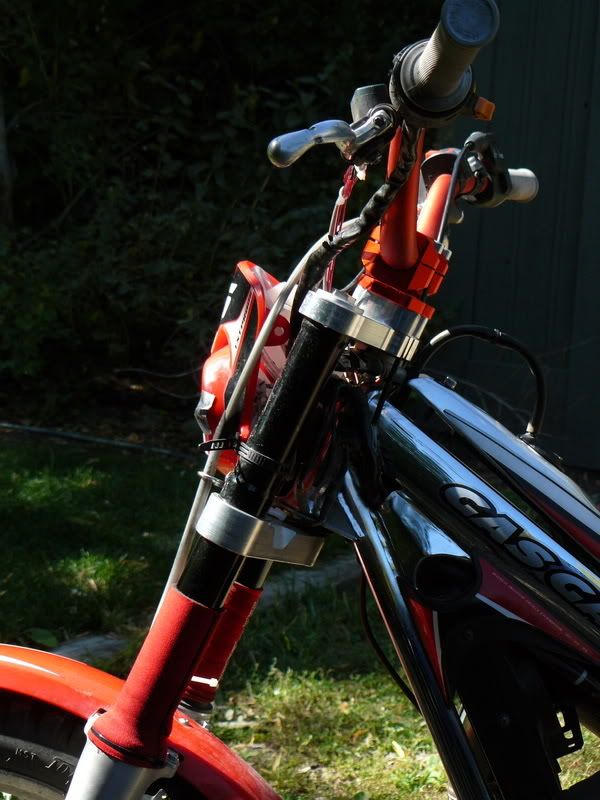
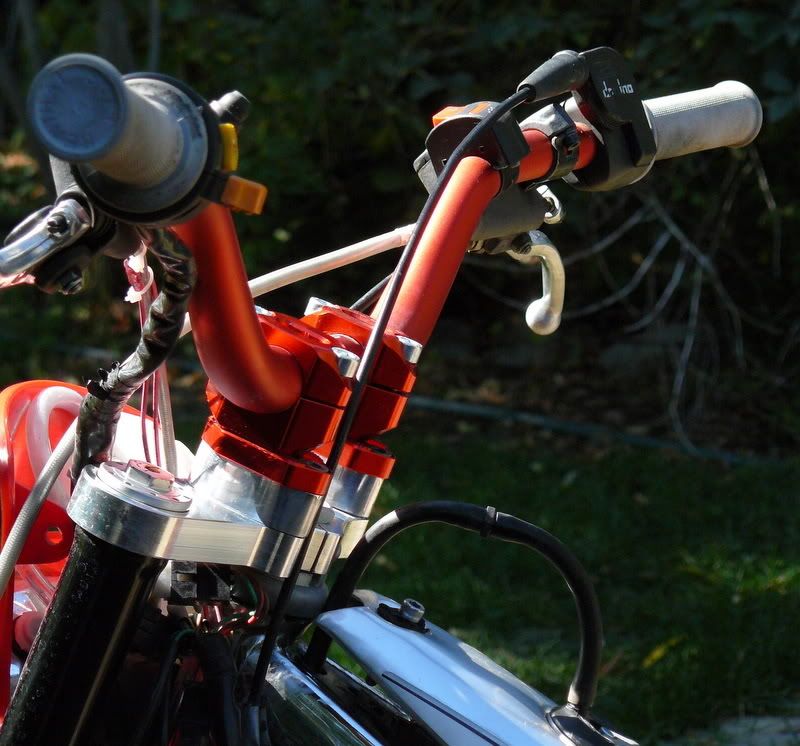
If you are tall—say over 6’, your lower back will get sore at first on trail rides. There are two things to do about this, get your bars up and forward, and keep riding. Your back gets stronger, and you learn how to adjust your stance to rest it as you ride. On my bike you can sit a bit, but the bike is a little scary to ride sitting. For some reason the handling totally changes.
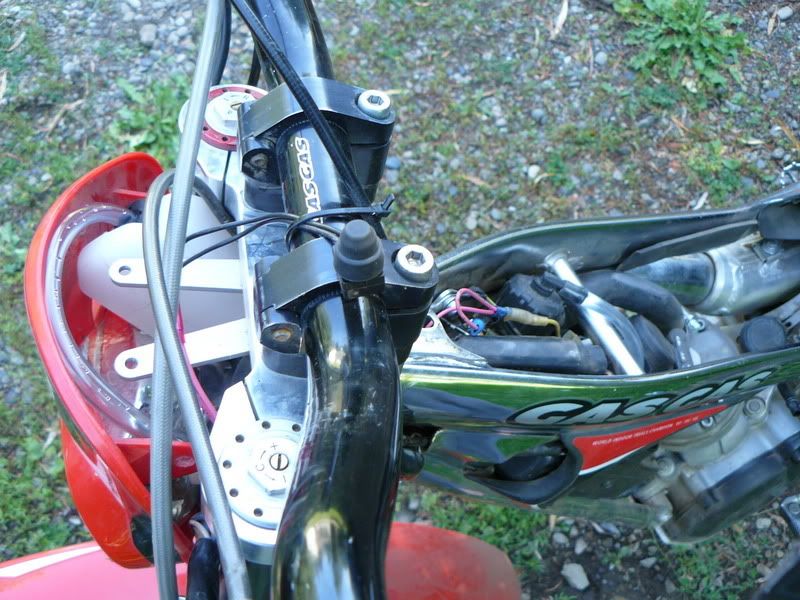
Bars and risers
Next thing you have to get used to is the tranny. You take your foot off the peg to shift. At first this is a shock, but you soon get used to it. The powerband is so huge you don’t really shift much. 1-4 are close. REALLY close. Closer than any CR on any MX bike by quite a bit. Then comes the “GAP”, and it’s more than just a huge jump in ratio. To make the tranny so small, it’s designed like no other. The result is 4 to 5 is an “interesting” change, up or down. You can’t take it for granted. God knows what is really happening in that box when you do this shift, but you can tell it’s complicated. Often, especially on downshifts you will hit a false neutral, which is frustrating if you are climbing, because you come to stop. Luckily you can start off anywhere and upshift to 4th no problem. The gear gap is probably the biggest drawback to seemless trail riding. I finally addressed this by gearing the bike up to unheard ratios with special sprockets. So my 1st is like most trials riders 4th. Still low enough to climb any pitch with traction, clutch out. 70% of the time I’m riding in 5th, which can go from about 5 mph to 40 mph. On flat ground you can actually start in 5th if you want, with no more clutch work than your KLR. The bike runs like a swiss watch at anything over 0 rpm, when the sweetest 4 stroke is clunking and knocking. I’ve never been on anything like it.
The next issue is overheating. On our terrain every bike boils over on the big climbs—even my SX with those fancy radiators. The thing about the GG is that it does not hold a lot of water, so if you let it boil…….and in the stock setup you don’t notice it easily, well the motor knocks and will sieze if you don’t shut it off shortly.
Adding water
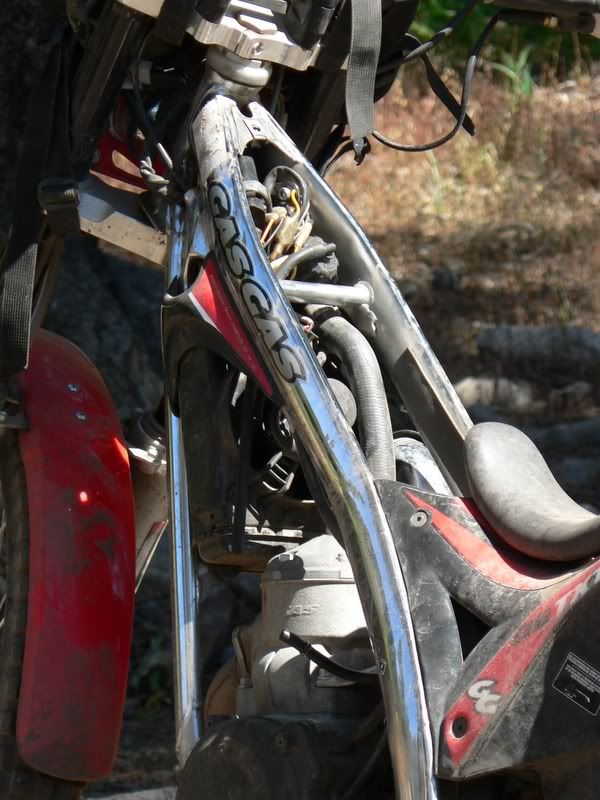
The good news is that if you let it cool and put water back in it, it will start up and get you home. The bad news is that if you got to this point, you will need to replace the O-Rings in the head to avoid constantly overheating from here on out. This only involves 6 bolts, and some clever seating, but it must be done.
O-Rings:

Outer one is fried:

New Nikosil coat

Base gasket, probably went because of early over heat

Replacement, you get an idea of the compact motor

After years of struggling with this issue, I finally have it under control, with two mods. Most important is an overflow tank, and less so, a manual fan switch. Stock, the fan relies on a thermostat to turn on the fan. Problem here is that if the fluid is below the thermostat, it doesn’t turn it on. It only has to happen once. Then it’s back to the o-rings etc. So I turn mine on on any climb or hard riding. Today I can make huge climbs, really on the gas, and it’s no problem. The over flow tank is in my view, so I know if it’s boiling. Worst case, I shut off the motor and it sucks the lost fluid back in and off I go---3-5 minutes tops.
Overflow tank:
Too much mud in radiator, cause I left off the guard..

Next potential fun stopper is your kick starting technique. If you stab at it, you risk breaking the kickstart gear, which then falls into other places and causes all kinds of damage. Thank God I’ve never done this, but early on I was changing the tranny oil, and…….


This is why it’s nice to have two bikes up here. If one is down you can ride the other. I was lucky, and the importer fixed this for me NC, but I did have to send him the motor. No problems and many miles since then.
Jesus, uhoh7, why do you put up with these quirks? Is it really worth it? Oh yes. To the point that today I ride this bike almost exclusively, even though the SX is modded to enduro perfection. The preference goes far beyond the increased mobility in technical terrain.
The bike has unmatched handling on “normal” Idaho single track. Front and rear it grips like super glue, and steers like a laser. You have line control which is inconceivable on ANY enduro bike. That means you can rip and rarely fall. If you ski, it’s like the difference between 1981 223cm downhill boards and modern 170cm carving skis. On top of that they are dead quiet, and have less trail impact than a hiker.
The crazy thing is that all the quirks mentioned above could be easily addressed by the manufacturer with a “wilderness” edition. All it really needs is different tranny ratios, a little better cooling, and a bolt on tank/seat combo. Unfortunately Gas Gas is oblivious to this fact. There is the Scorpa “T-ride”, but this bike is 200lbs. Forget that—well I’m sure it’s fun, but you give up too much.
One clue that this is all true is that trials bikes are now banned in the premiere enduro-cross class.
2010 GG 300 TXT PRO





